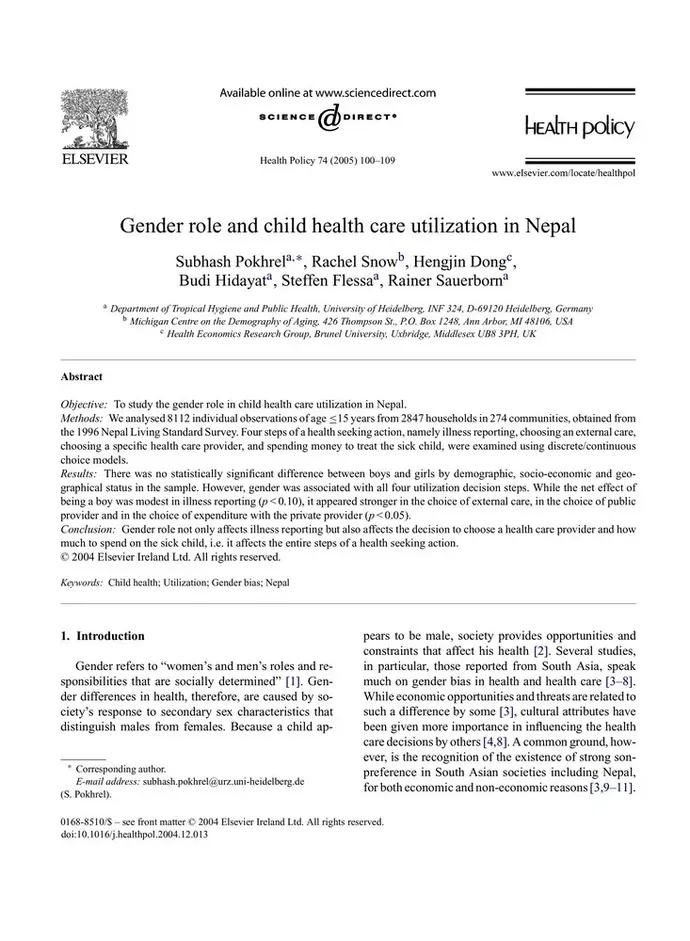
Gender role and child health care utilization in Nepal
Pokhrel, S.; Snow, R.; Dong, H.; Hidayat, B.; Flessa, S.; Sauerborn, R.
Health Policy 74(1): 100-109
2005
ISSN/ISBN: 0168-8510 PMID: 16098416 DOI: 10.1016/j.healthpol.2004.12.013Document Number: 255714
Objective: To study the gender role in child health care utilization in Nepal. Methods: We analysed 8112 individual observations of age <=15 years from 2847 households in 274 communities, obtained from the 1996 Nepal Living Standard Survey. Four steps of a health seeking action, namely illness reporting, choosing an external care, choosing a specific health care provider, and spending money to treat the sick child, were examined using discrete/continuous choice models. Results: There was no statistically significant difference between boys and girls by demographic, socio-economic and geographical status in the sample. However, gender was associated with all four utilization decision steps. While the net effect of being a boy was modest in illness reporting (p<0.10), it appeared stronger in the choice of external care, in the choice of public provider and in the choice of expenditure with the private provider (p<0.05). Conclusion: Gender role not only affects illness reporting but also affects the decision to choose a health care provider and how much to spend on the sick child, i.e. it affects the entire steps of a health seeking action.
Document emailed within 0-6 h